Laser hair removal: the right approach for your client
Reducing unwanted hair growth starts with a treatment plan tailored to your client. By assessing the skin, the hairs in the treatment area and the desired result together, you can identify when laser hair removal may be a good option.
At Innovaskin, we help you learn how to make that assessment. With an understanding of the technology, practical experience and personal guidance, you can build a service that you can confidently explain and deliver.
Recognise when laser hair removal is a good fit
Dark hairs with enough suitable pigment provide a good starting point for laser hair removal. The pigment, melanin, absorbs the laser light and converts that energy into heat. This can damage the hair follicle and reduce hair growth.
Hair thickness and the growth phase also play a part. As hairs go through different growth phases, several treatments are usually needed. A course of treatment gives you the opportunity to monitor progress and assess the result together with your client. Leeds Teaching Hospitals explains how pigment and the growth phase influence treatment.
The aim is long-term hair reduction that suits the client. How much reduction is achievable and whether maintenance is needed later will vary from person to person. The American Academy of Dermatology describes these differences in results and maintenance.
Assess skin and hair separately
Laser hair removal can be used on a range of skin tones, including dark skin. This requires suitable equipment, appropriate settings and a practitioner with experience of treating that skin tone.
You assess the suitability of the hairs separately. Skin type and hair colour tell you different things:
- The skin helps determine which equipment and treatment settings are appropriate.
- The hairs help determine whether there is enough suitable pigment for the laser light to target.
A device that can be used on different skin types does not automatically make every hair colour treatable. This distinction is part of how pigment-based laser hair removal works. The American Academy of Dermatology explains the difference between skin tone and hair colour.
Assess the possibilities in each treatment area
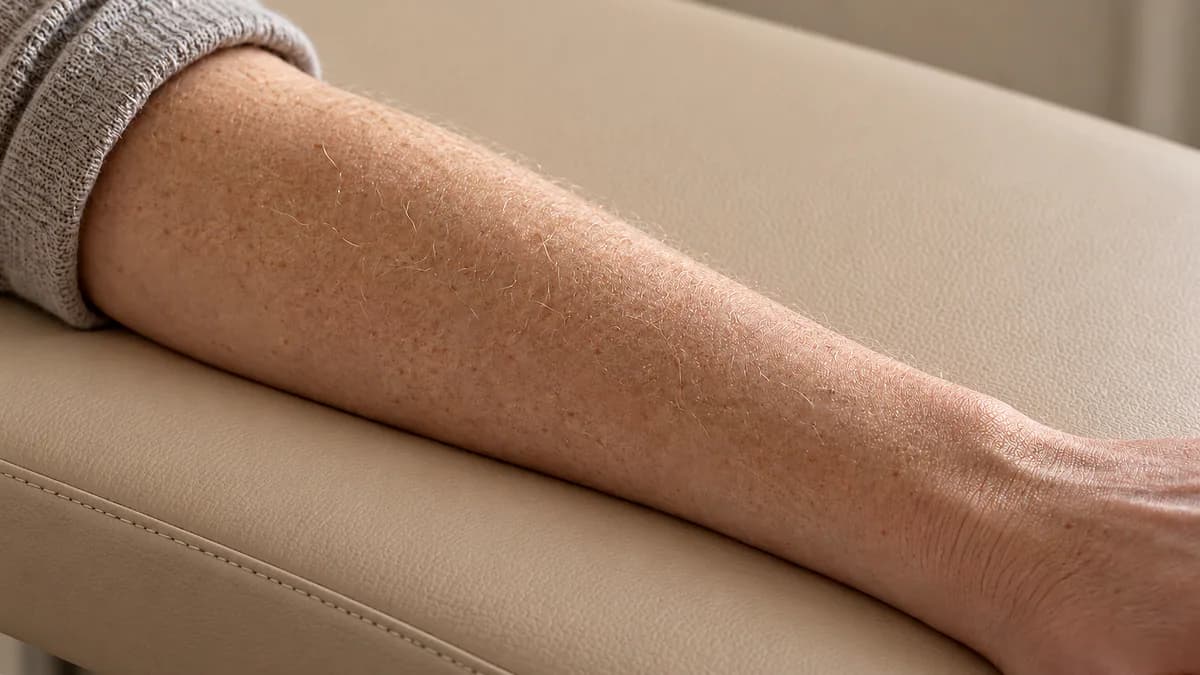
A good assessment starts with the hairs you actually want to treat. The colour of the hair on someone's head alone does not give you enough information. Look at the colour, thickness and distribution of the hairs in the area concerned.
For example, an area that appears grey may contain a mixture of dark and white hairs. If the rest of the assessment is favourable, reducing the dark hairs may be a suitable treatment goal. The white hairs are expected to remain.
For a client whose main aim is to have fewer dark hairs, that can be a valuable outcome. A client who wants every visible hair to disappear has a different expectation. Discussing this beforehand makes it clear what the client is choosing.
Give advice that suits each hair colour
Understanding the different types of pigment helps you explain the possibilities clearly. Brown and black hair mainly contain eumelanin. Pheomelanin predominates in red hair, while blonde hair contains little eumelanin. A visible hair colour therefore does not necessarily mean that enough suitable dark pigment is present. MedlinePlus Genetics describes how these pigments determine hair colour.
White hairs lack the pigment required. Reliable laser results should not be expected for blonde, grey or red hairs either; the American Academy of Dermatology lists these hair colours as unsuitable for laser hair removal. Read the explanation of suitable hair colours.
With this knowledge, you can give focused advice: which hairs are suitable, what the course of treatment may achieve, and when another hair removal method would better match your client's wishes.
Turn the consultation into a clear treatment plan
During the consultation, you connect your assessment with your client's goal. Discuss the treatment area, previous treatments, relevant medical information and the desired result. This conversation beforehand helps you carefully assess suitability and expectations. The American Academy of Dermatology describes the important topics to cover.
Then make the following points clear:
- Which hairs do we want to target with the treatment?
- What change does the client hope to see?
- Which hairs are expected to remain?
- How will we monitor progress?
Record what you have agreed. This gives you and your client a shared understanding of the treatment plan and a basis for discussing the result.
Put your knowledge into practice with Innovaskin's guidance
During our private laser hair removal training, we connect the theory with the day-to-day practice of your salon. You learn how laser hair removal works, which skin and hair types are suitable, and what to consider when it comes to safety.
You then practise under supervision with our ClearWave diode laser on a model. The training is one-to-one, with time for your questions and adapted to your pace and level of experience.
We also cover how to offer the treatments: how do you present laser hair removal to your clients, and how do you make it part of your business? After the training, you can continue to contact us with questions, for fine-tuning and for support with your first treatments.
This gives you practical tools to recognise when treatment may be suitable, use your equipment appropriately and give your clients clear guidance. Explore our private laser hair removal training.
Explore the possibilities for your salon
Would you like to add laser hair removal to your services? During a demonstration, we discuss your plans, introduce you to the equipment and look at how our training and support can help.
Arrange an introductory consultation through our training page.
Sources
- Leeds Teaching Hospitals NHS Trust — Laser Hair Reduction (opens in a new tab)
- American Academy of Dermatology — What causes gray hair, and can I stop it? (opens in a new tab)
- MedlinePlus Genetics — Is hair color determined by genetics? (opens in a new tab)
- American Academy of Dermatology — 6 ways to remove unwanted hair (opens in a new tab)
- American Academy of Dermatology — Laser hair removal: Preparation (opens in a new tab)
- American Academy of Dermatology — Laser hair removal: FAQs (opens in a new tab)